“Out From Under the Snow”
April 17, 2010
The third meeting of the mid-Atlantic Chapter of the League of World War I Aviation Historians
At the National Air and Space Museum’s facility at Dulles, The Steven F. Udvar-Hazy Center
I made the three and one half hour drive (each way) for my first visit to this regional meeting. I am glad I did. This meeting, held in one of the classrooms at Udvar-Hazy functioned almost as a mini-seminar, not unlike what the national organization holds every two years. The organizers, who double as NASM employees, had the classroom set up with a projector and sound system so the 20 -or-so attendees could take it all in.
NASM Curator Dr. Jeremy Kinney started it off with a presentation about the US aircraft production and testing at McCook Field in Dayton, OH during WWI. This was a companion presentation to the Kinney’s article on the subject published in the Winter 2009 issue of “Over the Front.” He reveled it was based on research he had completed for a paper in the 1990s and was a one time submitted as an entry in the League’s student paper contest.
Kinny did a fantastic job of illustrating his talking points with archive photos of actives at McCook. He provided insight into the politics of this testing initiative and how it lead to technological changes in the aircraft the US was trying to build for the war - though ultimately the conflict ended before any of this innovation could make it to Europe.
A lively question and answer session followed.
Charley Gosse was up next with a review of the various aircraft fabric “Indian Head” insignias of the Lafayette Escadrille which are part of the NASM collection (6 in all). Of course, I was hoping to see the actual pieces, but this was strictly a slide show. He covered his work with Alan Toelle to try and authenticate each by matching them up to photos of the escadrille. Gosse showed how though the main components of the designs were the same from example to example, the bows at the bottom of each were unique. Attention to these bows is where the authentication process usually starts, but not where it ends. As usual, getting to see the actual colors, both of the paint and of the fabric, adds to my visualization of the black & white photos of the era.
Prior to the lunch break there was a short segment where attendees got to talk a little bit about projects on which they were working - both books and modeling.
After lunch Blaine Pardoe jumped in with a presentation on Lafayette Flying Corps member, Frederrick Zinn. This presentation is related to a book Pardoe will have published later this year on Zinn’s actives in both WWI and WWII. Zinn, a Michigan native, was in France at the outbreak of the war and was one of the first American’s to volunteer as a member of the French Foreign Legion. He saw action with many of the American’s who would establish the Lafayette Escadrille and by extension the Lafayette Flying Corps. After being wounded, Zinn applied to be transferred to aviation and was assigned as an observer and gunner because - wait for it - his vision so poor he did not qualify as a pilot. Apparently Zinn was one of only three members of the Lafayette Flying Corps who was not a pilot.
Zinn spent an extensive amount of time in French two-seaters, and stayed in touch with ex-Legion American fliers, establishing life-long friendships with the likes of Burt Hall and Paul Rockwell. Having impressed Billy Mitchell during one of his visits to the front, Zinn was one of Mitchell’s first staff member requests when the US joined the War. Pardoe’s research indicates Zinn was instrumental in integrating members of the Lafayette Flying Corps into the US Air Service after most of them had been initially rejected based on poor results of Army-administered physicals.
At the end of the war, Zinn was commissioned, at his own urging, to locate the bodies of missing US fliers. According to Pardoe, Zinn was successful in locating about 295 of 300 missing airmen. The search process he established was ground-breaking. With the start of WWII, though a very unusual path, Zinn continued his work of recovering missing fliers. Pardoe’s book is not a biography of the man, but an exploration of Zinn and his search methods though the stories of a dozen or so fliers from both world wars whom he helped recover.
The day was closed by a presentation from Stephen Miller about his travels though France and America in search of aviation monuments and memorials. Through maps, aerial photography and personal images Miller covered a wide range of American, French and German markers. Many of these were graves, but he also tracked down several crash site markers as well as monuments to missing fliers or those whose graves were lost due to continued fighting during the war.
After the meeting and during lunch all the attendees got the chance to exchange notes and research tips. Thanks to the presentations and my conversations I was able to collect several new research sources I want to track down which are related to my projects. As usual at League meetings like this, all kinds of sharing took place.
I want to thank everyone for attending, presenting and organizing this great meeting. I am sure I will not be able to attend all of these meetings, but this one was sure worth the trip. I would encourage anyone in the region to attend these meetings if possible. I know I will be keeping an eye out for the agenda of the next gathering - they think it might be in July.
Monday, April 19, 2010


Friday, October 30, 2009
Return to the Cradle - Day 1, Presentation 1 (San Antinio Texas, Friday, Oct. 16)
League of World War One Aviation Historian's "Over the Front" Biennial Seminar
Return to the Cradle - Day 1, Presentation 1 (San Antonio Texas, Friday, Oct. 16)
Jim Wilberg presenting on Jean Navarre
 Jim Wilberg opened up the conference with his presentation on the early French ace, Jean Navarre. In what would become a sort-of “rebel” theme for the day, Wilberg compared the personality of Navarre against that of the fictional character/pilot “Maverick” from the movie Top Gun, and stated that many of the clichés for fighter pilots started with Navarre.
Navarre’s pre-war life was referenced, particularly his twin brother, Pierre, to whom he was very close. Wilberg covered the fact that Navarre, with few exceptions, was not close to many of his fellow pilots and was particularly affected when his few friends were killed in action and particularly when his brother, who also flew in the war, was killed.
There were good details on the aircraft Navarre flew as well has the units in which he served and the commanding officers he scrapped with as well as some of the aircraft he brought down.
A significant portion of the presentation was dedicated to the Battle of Verdun, where Navarre gained much of his fame by flying multiple missions per day over long periods, earning him the title “Sentential of Verdun” by the infantry in the trenches who came to recognize the constant presence of his red Neuport.
Wilberg closed by covering Navarre’s removal from combat and his death after the war.
Wilberg also mentioned a book he in publishing which compiles WWI aviation images by Russell Smith, and text by a stable of noted WWI Aviation writers, many of which were attending and presenting at the conference.
Return to the Cradle - Day 1, Presentation 1 (San Antonio Texas, Friday, Oct. 16)
Jim Wilberg presenting on Jean Navarre
 Jim Wilberg opened up the conference with his presentation on the early French ace, Jean Navarre. In what would become a sort-of “rebel” theme for the day, Wilberg compared the personality of Navarre against that of the fictional character/pilot “Maverick” from the movie Top Gun, and stated that many of the clichés for fighter pilots started with Navarre.
Navarre’s pre-war life was referenced, particularly his twin brother,
 Pierre, to whom he was very close. Wilberg covered the fact that Navarre, with few exceptions, was not close to many of his fellow pilots and was particularly affected when his few friends were killed in action and particularly when his brother, who also flew in the war, was killed.
There were good details on the aircraft Navarre flew as well has the units in which he served and the commanding officers he scrapped with as well as some of the aircraft he brought down.
A significant portion of the presentation was dedicated to the Battle of Verdun, where Navarre gained much of his fame by flying multiple missions per day over long periods, earning him the title “Sentential of Verdun” by the infantry in the trenches who came to recognize the constant presence of his red Neuport.

Wilberg closed by covering Navarre’s removal from combat and his death after the war.
Wilberg also mentioned a book he in publishing which compiles WWI aviation images by Russell Smith, and text by a stable of noted WWI Aviation writers, many of which were attending and presenting at the conference.
Thursday, October 15, 2009
San Antonio - Pre-Conference Gathering
Today I find myself for the first time in San Antonio, Texas for the 2009, Over the Front conference "Return to the Cradle."
After getting checked into my hotel room I ventured down to the meeting area for the traditional meet-and-greet gathering. As expected I saw a lot of the usual suspects and some faces who were not familiar to me.
The bonus in the attendee folder was a copy of the Over the Front 2009 calendar. Yes, I know 2009 is just about over, but I have been kicking myself for not buying a copy of this at the beginning of the year. I have seen the image of Russell Smith's "Lowenhardt" all over the place this year and really like it. This particular image is on July and I am admiring it as I type.
I did confirm that the Over the Front web site has been down for a few days due to some logistical problems, but should be back up soon.
The final schedule of presentations looks good with a mixture of subjects of which I have some knowledge and others I know nothing about.
I will try to add put some high-lights here each day.
After getting checked into my hotel room I ventured down to the meeting area for the traditional meet-and-greet gathering. As expected I saw a lot of the usual suspects and some faces who were not familiar to me.
The bonus in the attendee folder was a copy of the Over the Front 2009 calendar. Yes, I know 2009 is just about over, but I have been kicking myself for not buying a copy of this at the beginning of the year. I have seen the image of Russell Smith's "Lowenhardt" all over the place this year and really like it. This particular image is on July and I am admiring it as I type.
I did confirm that the Over the Front web site has been down for a few days due to some logistical problems, but should be back up soon.
The final schedule of presentations looks good with a mixture of subjects of which I have some knowledge and others I know nothing about.
I will try to add put some high-lights here each day.
Sunday, March 16, 2008
Alan Winslow Victory - April 14, 1918, vs. Jasta 64w
The Winter 2007 issue of Over the Front (Vol. 22, No. 4) contained two articles about the German unit Jasta 64w. One article, by Stephen Lawson, gives some detail about two aircraft of Jasta 64w which were shot down in April 14, 1918 in combat with Alan Winslow and Douglas Campbell, pilots with the U.S. 94th Aero Squadron. This article as well as a photo inside the back cover of the issue showing fabric removed from one of the German planes (courtesy of Alan Toelle), indicates there is still some confusion about the identities of the German pilots shot down that day.
Apparently the pilot of Campbell's victory was severely injured in the subsequent crash and later died. The pilot of Winslow's victory was not injured. The official record says the Uffz. Heinrich Simon was the Jasta 64w pilot who was made a POW and it was Vzfw. Anton Wroniecki who was listed as killed in action. Lawson's article mentions an earlier issue of OTF (Vol. 15, No. 3 - sorry I don't own this issue) were it was speculated that it was Wroniecki who survived. Supposedly he defected and the Army wanted to protect his identity, so they listed him as KIA.
In my research in the life of Raoul Lufbery (combat flight instructor assigned to the 94th Aero Squadron in the spring of 1918) I have had several research trips to the U.S. Army Heritage & Education Center at Carlisle Barracks in Carlisle, PA. This facility often has materials that duplicate those held by the National Archives, but it also has unique materials that have been donated to the U.S. Army and the facility over the years. On one trip I located a folder containing materials relating to the 94th Aero Squadron and in particular a letter from Alan Winslow written to his parents about the events of April 14, 1918. This letter was probably a copy but it was very old. It was typed, but it was not signed and did not contain any censorship marks that are common with letters of this type mailed during the war. Still, I think it was authentic and is a very interested read. It also alludes to the identity of the pilot of the plane shot down by Winslow. The letter had quite a number of grammatical errors. I have corrected the ones that might lead to confusion, others that are less serious I have left untouched. Part of this letter was printed in "The Hat in the Ring Gang" by Charles Woolley, but Woolley only includes part of this letter and leaves out the part about the pilot's identity. Please read on…
Apparently the pilot of Campbell's victory was severely injured in the subsequent crash and later died. The pilot of Winslow's victory was not injured. The official record says the Uffz. Heinrich Simon was the Jasta 64w pilot who was made a POW and it was Vzfw. Anton Wroniecki who was listed as killed in action. Lawson's article mentions an earlier issue of OTF (Vol. 15, No. 3 - sorry I don't own this issue) were it was speculated that it was Wroniecki who survived. Supposedly he defected and the Army wanted to protect his identity, so they listed him as KIA.
In my research in the life of Raoul Lufbery (combat flight instructor assigned to the 94th Aero Squadron in the spring of 1918) I have had several research trips to the U.S. Army Heritage & Education Center at Carlisle Barracks in Carlisle, PA. This facility often has materials that duplicate those held by the National Archives, but it also has unique materials that have been donated to the U.S. Army and the facility over the years. On one trip I located a folder containing materials relating to the 94th Aero Squadron and in particular a letter from Alan Winslow written to his parents about the events of April 14, 1918. This letter was probably a copy but it was very old. It was typed, but it was not signed and did not contain any censorship marks that are common with letters of this type mailed during the war. Still, I think it was authentic and is a very interested read. It also alludes to the identity of the pilot of the plane shot down by Winslow. The letter had quite a number of grammatical errors. I have corrected the ones that might lead to confusion, others that are less serious I have left untouched. Part of this letter was printed in "The Hat in the Ring Gang" by Charles Woolley, but Woolley only includes part of this letter and leaves out the part about the pilot's identity. Please read on…

Alan Winslow (center) standing in front of the German fighter he shot down on April 14, 1918.
c/o United States National Archives – College Park MD.
From Lt. A.F. Winslow 94th Aero Squadron
A.S.S.C. U.S.R. A.E.F. France.
Dearest Mother and Father:
If anybody was ever more happy than I am right now, I doubt it very much. I tried to cable you the news, but found it practically impossible from here; so I wrote Paul immediately and asked him to do it for me. But I suppose you already know something about it, for in the last two days I have been interviewed by nine reporters.
Here is the story:
On Sunday morning, April 14th, I was “on alert” from 6:00 A.M. till 10:00 A.M. that is, I with Lt. Douglas Campbell of Harvard and California, were on emergency call duty. We were sitting in the little alter tent, playing cards, waiting for a call. Our machines were outside, ready at a moment’s notice. I was patrol leader. At 8:45 I was called to the ‘phone, told by the information officer, who is in the direct touch with all batteries and observation posts, that two German aeroplanes were about two thousand meters above the city, which is only a mile or so from here. We were told that they were going east. We were rushed down to machines in side cars, and in another minute were off in the air. Doug started ahead of me, as I was to meet him above a certain point at five hundred meters, and then take the lead. I gave him about forty-five seconds’ start, and then left myself, climbing steeply in a left-hand spiral, in order to save time. I had not made a complete half-turn, and was at about two hundred and fifty meters, when straight above and ahead of me in the mist of the early morning, and not more than a hundred yards away, I saw a plane coming toward me with huge black crosses on its wings and tail. I was so furious to see a Hun directly over our Aviation field that I swore out loud and violently opened fire. At the same time, to avoid my bullets, he slipped into a left-hand reversement, and came down firing on me. I climbed, however, in a right-hand spiral, and slipped off, coming down directly behind him and “on his tail”. Again I violently opened fire. I had him at a rare advantage, which was due to the greater speed and maneuverability of our wonderful machines. I fired twenty to thirty rounds at him and could see my tracers entering his machine. Then, in another moment, his plane went straight down in an uncontrolled nose-dive – I had put his engine out of commission. I followed in a straight dive, firing all the way. At about six feet above the ground he tried to regain control of his machine, but could not and he crashed into earth. I started down near him, made a sharp turn by the wreck, to make sure he was out of commission, then made a victorious swoop down over him, and climbed up again to see if Doug needed any help with the other Hun: - for I had caught a glimpse of their combat out of the corner of my eye.
I rose to about three hundred again, to see Doug “on the tail” of his Boche, and his tracer bullets were passing throughout the enemy plane. I climbed a little higher, and was diving down on his second Hun, and about to fire, when I saw the German plane go up in flames and crash to earth. Doug had sent his Hun plane down one minute after I had shot down mine.
Mind you, mother, that the fight took place only three hundred meters up, in full view of all on the ground and in the near-by town; mine dropped about one hundred yards to the right, and Doug’s one hundred yards to the left of our field. These are remarkable facts, for one of our Majors, who, with the French army since 1915, has shot down seventeen machines, never had one land in France – and here we go, right off the bat and stage a fight over our aerodrome and bring down two Huns right on it. It was an opportunity of a lifetime – a great chance.
When we landed, only our respective mechanics were left in the drome, to help us out of our flying clothes. The whole camp was pouring out, flying by on foot, bicycles, side cars, automobiles; soldiers, women children, majors, colonels, French and American – all poured out of the city; in ten minutes several thousand people must have gathered. Doug and I congratulated each other, and my mechanic, no longer military, jumping up and down, waving his hat, pounded me on the back instead of saluting, and yelled: Damn it! That’s the stuff, old kid!” Then Campbell and I rushed to our respective Hun Wrecks.
On the way there – it was only half a mile, I ran into a huge crowd of soldiers – blue and khaki – pressing about one man. I pushed my way through the crowd, and I heard somebody triumphantly say to the surrounded man in French: “There he is; now you will believe he is an American.” I looked at the man – a scrawny, poorly clad, little devil, dressed in a rotten German uniform. It was the Hun pilot of the machine I had shot down. Needless to say, I felt rather haughty to come face to face with my victim, now a prisoner, but did not know what to say. It seems he would not believe that an American brought him down. He looked me all over, and then asked me in good French if I was an American. When I answered, “Yes,” he had no more to say. First I stood on one foot – eyeing him all the time, contempt and victory written on my face – then on the other foot, then lit a cigarette – (I did not give him one, as one paper said.) Then I coughed, and finally managed to ask him if he was hurt. When he replied, “No”, I turned, and left him in charge of some other officers, while I ran over to the wrecked plane.
There was a huge crowd around it, and the first man I ran into was our major – the C.O., - and he was the happiest man in the world outside of me and Doug. After him, everybody began shaking my hand. It was an awful time for me. A French and an American General blew up in a limousine to congratulate me – colonels, majors, all the pilots, all the French officers, mechanics, - everybody in the town and camp. All had seen the fight. One woman, an innkeeper, told me she could sleep well from now on, and held up her baby for me to kiss. I looked at the baby, and then felt grateful to my major, who pulled me away in the nick of time. I had my mechanic take off everything available – the machine was a wreck – but I got some splendid souvenirs. The big black German crosses from the wings, his rudder, pieces of canvas with holes from my bullets in them, all his spark plugs, his magnetos, his mirror, clock, compass, altimeter, his clumsy signal revolver, etc. – it is a great collection. After I had gathered all this stuff, and had my mechanic take it back to camp, the photographers began to arrive, and then there was another awful time. When that agony was over, they wheeled what was left of the Hun plane back to our field, and then the photographers got excited all over again. Nevertheless, they got a wonderful lot of interesting pictures, - the duplicates of some I will send you under separate cover, for I don’t date trust many to the mails. I will keep all the films.
Doug returned from similar experiences, and then they worked on both of us all over. He had set his Hun machine on fire at three hundred meters, and it had fallen in flames, rolling over three times, and then completely burning up. There remained but a charred wreckage, like the sacrifice of some huge animal. The Hun pilot had been thrown out and was badly off. His face, hands, feet, nostrils and lungs were all burnt, while his leg was broken. He is now in hospital and my Bosche is probably commencing is job of ditch dogging for the rest of the war.
They got much valuable information off my man – the other couldn’t speak. But I can’t of course give that out. However, he was a Pole, said he was not an officer because he was a Pole. Although he had been an “aspirant” and a pilot at the front for two years. He said to me, with a sort of sigh of relief, throwing up his hands at the same time, “Alors, la guerre est finis pour moi!”
That afternoon my wrecked Hun plane and the charred result of Doug’s good work were exhibited in the public square of the town, surrounded by an armed guard, and overlooked by a French Military band. Not only was it a great day for me, Doug, the Major and the whole squadron, but it was a great day for the townspeople, and has had a good moral effect. You can imagine it, when you realize it took place above their roof tops, at only three hundred meters, and that they were able to see the whole fight. The Americans are indeed welcome in the town now, and I can Doug can buy almost anything half price.
An amusing incident was this, the fight was no near to earth that bullets were flying dangerously all about the ground, No one was hurt, save a French worker in the field, who received a hole through his ear from one of my bullets, and is very proud of it.
Two days later was another happy day, for Doug and I were both decorated by the French Colonel (side to the general of this army) with the Criox de Guerre with a Palm Leaf. That is equivalent to two Croix de Guarres, and you can well imagine I am proud – that was the proudest moment of my life. Also I have received a fine letter from the Chief of the Air Service, and have been mentioned in the General Orders. Likewise the General of the Division of the American Army in this sector came to pay me a visit. Furthermore, I have been proposed for the American Distinguished Service Cross, and for a promotion. Isn’t that all splendid?
The ceremony of giving the Croix de Guerre with a palm was all very impressive. The whole squadron was on parade, all the French officers, nearby, attended and the French Colonel made an excellent speech. I was a little nervous, but passed it off and everything went off smoothly. The official staff photographers were there, with their movie camera and took the whole thing. Then we had to make fools of ourselves for the movies, after it was all over, by putting on our helmets, climbing in and out of our machines and trying not to be embarrassed. It was awful. Those pictures are to be shown in America as official war photographs in about four to six weeks, so you might look out for them.
I received authority to get a duplicate “Croix de Guarre” which I am sending under separate cover to you. Also, I will send some photographs, and a piece of the canvas from the cross on the rudder of the Hun plane I shot down.
My dearest love to you, dear mother and dad, from the happiest son of the world.
Alan.
April 17, 1918
P.S. You have published some of my letters, but please do not publish even part of this, as it is too personal.
I am told that the two wrecked Hun planes are to be exhibited in America as a boomer for the Liberty Loan. It would be great if you could see them. You see they are the first two Hun planes brought down in France by the American air service, and I was the first to bring one down by one minute.
I will also send you duplicates of the official letters I received from the Chief of Air Services, from the French Commander, and my Croix de Guerre citation, etc.
Alan.
______________
In the Douglas Campbell's book "Let's Go Where the Action Is!" there is included a letter with Campbell's account of his victory on April 14, 1918. The editor of the book, Jack Eder, included in his notations a journal entry from Col. Frank P. Lahm. He describes the injured pilot as "...a big husky typical German, 24 years old..." He does not describe the nationality of the other, non-injured pilot, but he does ask the pilot if he is an officer, to which the pilot replied, "Je suis adjutant."
In this particular notation, Eder, the editor of the book takes issue with Lahm identifying Winslow's kill as an "Albatross." Eder not only maintains that Winslow's kill was a Pfalz, but he goes on to say that "Neither Campbell or Winslow ever got to meet either of the men they had brought down."
This book was published in 1984, and obviously Mr. Eder was unaware of the Winslow letter included in this posting. Given the confusion about this combat I think Mr. Eder did the best he could. This blog posting is simply to bring another piece of the puzzle into the light and maybe spark some conversation.
Your comments and input would be appreciated.
Monday, March 3, 2008
Review: Over the Front - Winter 2007 - Vol. 22, No. 4

Hats off to issue editor, Alan Zakrzewki, for the contents of the Winter 2007 issue of "Over the Front" (Volume 22, Number 4). The issue is built around two main subjects; the US 141st Aero Squadron and the German Jasta 64w.
According to Zakrzewki, the 141st came into the war late and for some reason was not included in the Gorrell Reports, which contain the official histories of most US flying units in WWI. So, the first piece in this issue is a word-for-word history of the 141st Aero Squadron as it was recorded. This history includes the time immediately after the war’s end with impressive photos of the pilots, support staff and the unit’s aircraft. This is followed by the letters and diary entries of 2nd Lt. Horace Hallock Brown of the 141st Aero Squadron. These two pieces work well together and together provide a good working account of the unit.
The Jasta 64w pieces are of particular personal interest, because they cross over with my research into the life of Raoul Lufbery, who in the spring of 1918 was part of the 94th Aero Squadron operating in the same sectors opposite Jasta 64w. The first article, written by Stephen Lawson (a curator at the Lafayette Foundation museum in Colorado), provides a chronological history of the personnel and operations of the German unit. The article also details of the first US aviation victories of the war – against Jasta 64w – by 94th Aero Squad pilots Alan Winslow and Douglas Campbell on April 14, 1918.
Additionally, Lawson sheds a bit more light on the controversy surrounding US pilot Oscar Jay Gude. Gude started out assigned to the 94th Aero Squadron, and was in the air and part of the failed attach against a German aircraft on May 18, 1918. It was this attack that resulted in the death of Raoul Lufbery. Members of the 94th called Gude a coward for his conduct during this time. Gude was later re-assigned to the 93rd Aero Squadron (possibly in part for his conduct on May 18). On Oct. 22, 1918, Gude essentially surrendered to the German’s by landing his perfectly functioning plane at the airfield of Jasta 64w. The article references Charles Woolley’s excellent book “Echoes of Eagles” for details, but provides in this article exceptional photos of Gude’s plane in German hands, as well as Gude in the back seat of a German staff car being driven away.
Next up is a short piece by Terry Phillips featuring more photos of Jasta 64w later in 1918 along with more personal information on the pilots, their planes, and a certain German nurse known as “Lot.” This is a very nice accompaniment to the Lawson article.
The Rare Bird section is by Jack Harris and is dedicated to the Fokker C.I., which is generally described as a two-seater version of the successful Fokker VII. This particular article also indirectly functions as a follow-up to the piece on the Netherlands Army Air Service in Over the Front Vol. 21, No. 1. The C.I. was developed by Fokker at the end of the war and never saw combat. As told in the earlier article, Fokker, a Dane, was desperate to get out of Germany at the end of the war, and was able to negotiate or bribe passage for himself and several hundred partially assembled aircraft from his factory to the Netherlands. Many C.I. aircraft were in these shipments and so had extended post-war military and civilian uses.
An article by Wade L. Eakle provides the history of Snoopy and the Red Baron as part of cartoons created by Charles Schultz. Eakle explains how Schultz first came up with the idea to make WWI part of his drawings. More than 10 pages of reprints included in this issue provide and overview of the 397 WWI-themed cartoons Schultz created over 34 years.
According to Zakrzewki, the 141st came into the war late and for some reason was not included in the Gorrell Reports, which contain the official histories of most US flying units in WWI. So, the first piece in this issue is a word-for-word history of the 141st Aero Squadron as it was recorded. This history includes the time immediately after the war’s end with impressive photos of the pilots, support staff and the unit’s aircraft. This is followed by the letters and diary entries of 2nd Lt. Horace Hallock Brown of the 141st Aero Squadron. These two pieces work well together and together provide a good working account of the unit.
The Jasta 64w pieces are of particular personal interest, because they cross over with my research into the life of Raoul Lufbery, who in the spring of 1918 was part of the 94th Aero Squadron operating in the same sectors opposite Jasta 64w. The first article, written by Stephen Lawson (a curator at the Lafayette Foundation museum in Colorado), provides a chronological history of the personnel and operations of the German unit. The article also details of the first US aviation victories of the war – against Jasta 64w – by 94th Aero Squad pilots Alan Winslow and Douglas Campbell on April 14, 1918.
Additionally, Lawson sheds a bit more light on the controversy surrounding US pilot Oscar Jay Gude. Gude started out assigned to the 94th Aero Squadron, and was in the air and part of the failed attach against a German aircraft on May 18, 1918. It was this attack that resulted in the death of Raoul Lufbery. Members of the 94th called Gude a coward for his conduct during this time. Gude was later re-assigned to the 93rd Aero Squadron (possibly in part for his conduct on May 18). On Oct. 22, 1918, Gude essentially surrendered to the German’s by landing his perfectly functioning plane at the airfield of Jasta 64w. The article references Charles Woolley’s excellent book “Echoes of Eagles” for details, but provides in this article exceptional photos of Gude’s plane in German hands, as well as Gude in the back seat of a German staff car being driven away.
Next up is a short piece by Terry Phillips featuring more photos of Jasta 64w later in 1918 along with more personal information on the pilots, their planes, and a certain German nurse known as “Lot.” This is a very nice accompaniment to the Lawson article.
The Rare Bird section is by Jack Harris and is dedicated to the Fokker C.I., which is generally described as a two-seater version of the successful Fokker VII. This particular article also indirectly functions as a follow-up to the piece on the Netherlands Army Air Service in Over the Front Vol. 21, No. 1. The C.I. was developed by Fokker at the end of the war and never saw combat. As told in the earlier article, Fokker, a Dane, was desperate to get out of Germany at the end of the war, and was able to negotiate or bribe passage for himself and several hundred partially assembled aircraft from his factory to the Netherlands. Many C.I. aircraft were in these shipments and so had extended post-war military and civilian uses.
An article by Wade L. Eakle provides the history of Snoopy and the Red Baron as part of cartoons created by Charles Schultz. Eakle explains how Schultz first came up with the idea to make WWI part of his drawings. More than 10 pages of reprints included in this issue provide and overview of the 397 WWI-themed cartoons Schultz created over 34 years.
“Over the Front,” is a quarterly publication by the League of WWI Aviation Historians.
Friday, February 22, 2008
Students building flying WWI Replicas
Students of the Aviation Institute of Maintenance (AIM) are in the process of building WWI replicas as part of their education. AIM is a program teaching students to become aircraft technicians at eight campuses. Most of the individual classes at AIM focus on specific aircraft components and systems. The difference of the WWI Student Project is that students are allowed to work on whole aircraft.
The program is set up so each campus will build an individual aircraft as teams. Each team started out by evaluating and selecting which type of aircraft they wanted to build. The aircraft will use modern engines and using modern construction techniques (modern wing designs, metal structures instead of wood, etc.)
Once the planes are completed, they will go through pre-flight and flight-testing and then will be available for local events and air shows. They will also be transported to the AIM location in Virginia Beach, Virginia, where they will be flown and be evaluated by judges.
Each team is maintaining a blog to track the progress of their projects, and post photos of the students doing the work. According to these blogs many of the teams are learning about WWI in the process, often visit regional museums to see historic examples of the replicas they are building.
Team Atlanta - Sopwith 1 1/2 Strutter
Team Dallas - Sopwith Pup
Team Indianapolis - Nieuport 11
Team Kansas City - Morane Saulnier AI
Team Manassas - The Avro 504
Team Orlando - Fokker DVIII
Team Philadelphia - Nieuport 17
Team Virginia Beach - Nieuport 24
Tuesday, February 12, 2008
WWI Aviation Monuments - Memories in Public Art
 In the Fall 2007 issue (Vol. 22, #3) of Over the Front (League of WWI Aviation Historians), there was a great article about monuments in the US erected in tribute to aviators of the Great War: Soaring Like Eagles Into New Heavens: American First World War Aviation Monuments and Memorials (Part 1), by Michael Barton.
The article includes photos and provides some background on several monuments including:
“The Aviator,” memorializing James Rogers McConnell – located at the University of Virginia. McConnell started out as an ambulance with the American Field Service, then switched to aviation and eventually flew as a member of the French escadrille, N124 (aka Escadrille American or Escadrille Lafayette). The sculptor was Gutzon Borglum who is best known for his work on Mt. Rushmore.
“The Aviator,” memorializing Louis Bennett Jr. – located in Wheeling, West Virginia. Bennett flew with No. 40 Squadron of the Royal Flying Corps. The sculpture was created by Henry Augustus Lukeman, who did several different WWI memorial sculptures around the United States.
The Norman Prince tablet – located in Memorial Hall, part of the Massachusetts State House in Boston. Prince started the war in the French Foreign Legion and is mostly credited with coming up with the idea for an all-American, volunteer flying unit that would eventually become the Escadrille Lafayette and by extension the Lafayette Flying Corps. Is first flying assignment was as a bomber pilot with escadrille VB 113.
The tablet was designed by John Paramino. Also described in the article is the elaborate crypt in the National Cathedral in Washington D.C. where Prince’s body was eventually placed. The body of Prince was originally supposed to end up in the crypt of the Lafayette Flying Corps Memorial in France. Due to a disagreement with other organizers of the monument about the prominence of Norman Prince in the promotion of the monument, his parents instead financed the abbey in the National Cathedral where is crypt resides.
Maintenance and protection of these types of monuments is at a critical stage. Many were created between the WWI and WWII are anywhere from 75-85 years old. As geographies of cities and towns have changed, many of these monuments are no longer in what would now be considered prime locations. The area around these monuments and the monuments themselves may be in need of a little TLC. In some cities, much larger and more prominent memorials to WWII and other conflicts have eclipsed the prominence and recognition of memorials to the Great War.
Since the official change of “Armistice Day” to “Veterans Day” it seems that all things about WWI have fallen out of the public’s attention. With the number of surviving veterans of WWI now countable on one or two hands, memories of the war dead and even those who knew them are now passing into permanent history.
Unfortunately vandalism of these monuments is a concern, and more recently so is theft, as the value of metals of all kinds is on the rise. A recent article in the New Yorker laid out the dollars and cents of the scrap metal business, and mentioned the malicious destruction of statues and public objects of art in the quest for scrap metal dollars. Monuments and even veterans’ graveside flag-holders are at risk. As we get closer to the 100th anniversary of WWI, it would be a shame to see its memorials disappear into scrap heaps of greed.
Many cities now require new monuments of any variety to include endowments for their perpetual up-keep but municipal budgets often have no available funds to maintain or repair their existing memorials. In many cases repair and up-keep of war monuments falls on the shoulders of local veteran groups and community organizations.
Brittan in particular has organizations dedicated to the preservation and protection of its war memorials. In general there seems to be some of the same activity going on in France. (Note the recent refurbishment of the Lafayette Flying Corps Memorial in St. Cloud, among others.) Also, there are individual preservation efforts also going on around the U.S.
Of course there are also recent additions to the WWI monument inventory. The new St. Omer British Air Services Memorial funded by the British Cross and Cockade International should be recognized – with funds set aside for upkeep. The US Liberty Memorial Monument in Kansas City has also gone through a major upgrade and a new museum has been created at the facility.
The following photos were taken of monuments in Philadelphia:
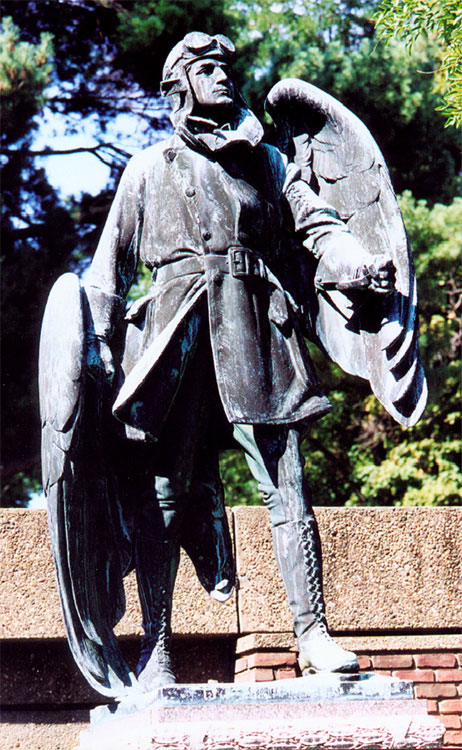
The first photos are of the Aero Memorial dedicated to Pennsylvania fliers who were killed in action during WWI. In addition to the central statue it includes walled in spaces around it bearing quotes related to war and flying.
 One of the quotes, from a poem by Stephen Spender, includes the fraise (“…the vivid air”) for which this blog was named. (This phrase was also used by the historian and author Philip Flammer for his book on the Lafayette Escadrille).
Thou hast caught splendor from the sailless sea, and mystery from many stars outwatched. - Stephen Phillips
Master and Maker. God of right the soldier dead are at thy gate who kept the spears of honor bright and freedom's house inviolate. - John Drinkwater
Born of the sun they traveled a short while toward the sun, and left the vivid air signed with their honor. – Stephen Spender
Death makes no conquest of the conqueror for now he lives in fame though not in life. - William Shakespeare
Master and Maker. God of right the soldier dead are at thy gate who kept the spears of honor bright and freedom's house inviolate. - John Drinkwater
Born of the sun they traveled a short while toward the sun, and left the vivid air signed with their honor. – Stephen Spender
Death makes no conquest of the conqueror for now he lives in fame though not in life. - William Shakespeare
 This monument was planned during the war by the Aero Club of Pennsylvania it was not erected until 1948. The whole space was refurbished in the past few years, and looks new. It has a prominent location across the street from the main entrance of the Franklin Institute, and also near the Philadelphia Free Library and not far from several art museums. The artist, Paul Manship, also created Prometheus at Rockefeller Center in New York City.
The second set of photos shows a monument very close to the first dedicated to African-American veterans of all wars. It features figures in mostly WWI uniforms. For obvious historic reasons, there are no figures in flying gear.


The third set of photos is of a more typical Dough-Boy statue on the end of a neighborhood known as Northern Liberties. It is dedicated to veterans of the sixth, eleventh, and twelfth political wards of that part of Philadelphia.


Readers, do you have any significant WWI monuments in your area – aviation themed or otherwise? If so, are they in good condition? Do they get any notice by members of your community?
Subscribe to:
Posts (Atom)